Wednesday, December 19, 2012

Happy Holidays!

Writer Beware is taking time off for the holidays. Unless there's some especially major publishing news, look for us to be back after January 1.

I'll still be answering emails. To contact me: beware [at] sfwa.org.

We wish all our readers peace, happiness, and excellent writing. Thanks so much for being here, for reading and commenting and sharing your experiences and spreading the word. See you in 2013!

Wednesday, December 12, 2012

Guest Blog Post: International Writing Scams and How to Protect Yourself

Posted by Victoria Strauss for Writer Beware

Today's guest blog post, from journalist Mridu Khullar Relph, explores the world of writing schemes and scams from an international perspective--something that's increasingly an issue for Western writers looking to find work overseas. Some of the scams Mridu identifies below may sound familiar, but there's nearly always an international twist.

Other resources: see my 2011 blog post on literary scams in India. Author Sameer Kamat also covers India-based schemes and scams on his blog.

If you've done overseas work and have run into any of these scams--or if you've encountered other scams that you think writers should be aware of--please post your story in the comments. It's one thing to provide general information about what writers should avoid, but what really hits home is personal experience.

 _____________________________

International Writing Scams and How to Protect Yourself When Doing Business Abroad
by Mridu Khullar Relph

Even as recently as five years ago, the covers of major news magazines were screaming themselves hoarse about the outsourcing of publishing, the writing of your local newspapers abroad, and the taking away of editorial jobs from the West and passing them off to the East.

Well, that hasn't happened (editors and agents are still happily in business in New York, thankfully). But what has happened, and what will continue to happen, is that the world, especially the publishing world, has become a smaller place.

The talent still rises to the top, but where that talent came from a few select countries before, now it comes from the world over. The Internet has opened up opportunities for the unknown non-Western writer to get published in the West, but what is even more interesting is that it has opened up an entirely new, global market for the Western writer who can access new markets, readers, and opportunities at the click of a button.

While that's great news, it's also where part of the trouble comes in. Because although doing business abroad can be a fantastic idea, scams don't respect international borders. Inevitably, you're going to encounter dodgy situations--some that you may recognize, but others that you may be unfamiliar with in your own country.

Here are some of the most common scams you may run across in the writing and publishing industry abroad, and tips on how to avoid falling for them.

The Scam: Paying the agent


Agents who ask you to pay fees upfront are a pretty common scam in the US, but (and this is confusing), this is not always the case abroad.

For instance, I know a very reputable agency in India, my home country, that actually accepts every manuscript that comes their way and charges to edit, polish and then submit the idea to publishers. These guys have posted deals on Publishers Marketplace and they're pretty upfront about how they function, so they're a serious agency, but they also charge. Without context and background, they may seem to be a scam--but they're actually not.

So what do you do if you have, say, a book that could do potentially really well in India? Is it worth going through this agency--or another like it?

What I recommend is always e-mailing clients, customers and people who've forked over the cash, no matter which country they're in, to ask about their experience. Are they satisfied? Were there problems? If you can't go yourself, send a friend to a bookstore in that country (or look through their online bookstores) to see which publishers have bought the titles the agency claims to have sold, and whether those titles are on the shelves. When it comes to an agency, you should always be able to talk to at least one client and see a number of recognizable book titles on their list before you decide whether they're legit or not.

And if writers or customers have had problems, or you can't find a single book or client? Run, don't walk. It may not turn out to be a scam after all (just an inexperienced agency), but do you really want to take that risk?

The Scam: "Please send me your books"

When you've published a book, especially one that's selling well, sooner or later you'll receive an e-mail that goes something like this: "Dear Writer, I am a huge fan of your work, your website, your Twitter, your Facebook, every single word you’ve written on the Internet. Now you have a book out and I would love to buy said book, but it isn't available in my impoverished country. Could you please Fedex me ten copies?"

First, you'll be flattered. Then, you'll rally against a world in which people have no books and be thankful for the fact that you do. Then, and only then, will you notice that last little bit at the end. Uh, ten copies? Why does this person need TEN COPIES?

This isn't always a scam, obviously. Sometimes, it's a teacher who genuinely wants copies for his school library or a woman who'd like some for a new book group she's formed. And let's face it, if it does turn out to be scam, you're at most out of a few copies of your own book. Like when you're charged more by cab drivers because you look like a tourist, it's more about the principle than the actual monetary value of the books.

To check, you could Google the name of the person who's sent you the request, see if they've ever actually commented on your blog or follow you on Twitter. And of course, you can check where they live and how difficult it is to actually get books there. Surely someone with access to the Internet wouldn't mind downloading the e-copies you're willing to send?

The Scam: Editors/manuscript evaluation services/e-course instructors

They're everywhere these days in the era of self-publishing, many of them fantastic, some of them not. In fact, you'll find frequently, through bitter experience unfortunately, that many people who call themselves "editors" have no editing experience at all and that e-course instructors who want to teach you how to make an income freelancing, often are making their own income solely through teaching.

In fact, just last week a freelancer wrote to me (with no hint of irony, I might add) saying that she was having a lot of trouble getting new assignments and thought the market was dying up, so she was taking up teaching freelancing instead. This woman has credentials--but that means absolutely nothing because her credentials aren't allowing her to sustain a happy career.

Here's a tip: Whenever you're considering hiring someone from overseas as an editor, to evaluate your manuscript, or to teach you something, make sure that you know the actual CURRENT professional qualifications of that person--and that you understand what those qualifications mean. When someone says they've been published in some of the top publications in, say, Brazil, look at these top publications and the standard of their content and then decide whether it's something you can respect. When writers say they've been published in "national magazines," what nation are they referring to? What publications? And do publications in that nation have writing standards you respect?

In some cases, these so-called editors and teachers will simply take off with your money. If you can, never pay all of it upfront.

The Scam: Virtual assistants and content outsourcing agencies

If you've ever considered lightening your workload by outsourcing some of the grunt work to somebody else, you'll no doubt have come across virtual assistants and content outsourcing agencies, who'll offer to do the research and administrative work for you.

Many of these (the cheaper ones, anyway) are located abroad, usually in Asia. And while there are many many good ones, there will always be a few that will take your money and deliver sub-standard work, if they deliver at all.

The way to escape this scam? References, references, references. That is the only way to start doing business with people outside your own country. Word of mouth. Run Google searches. If something negative comes up, don't ignore it! Investigate it, if you can. Make sure a phone number is provided--and make sure to call it, to see if you can actually communicate with the person on the other side. You'll be surprised at how many outsourcing agencies list numbers that don't actually exist--or have staffers attending phones who can't communicate with you. What happens when you have an emergency situation and need to talk to a live person on the phone?

The Scam: Publications who hire you with no intention of paying

Like in your own country, publications guilty of this will include magazines, e-zines, even national newspapers (no kidding!). One of my least favorite personal experiences with this is when a publication in the UK asked me to write for free. I told them I couldn't, stated my fee, and was pleasantly surprised when they agreed to pay it. Well, they got the piece for free anyway because they ran my article and never bothered paying me. Turns out, I wasn't the only sucker who got scammed into this. They'd hired several writers from various countries (including the UK) with no intention of ever paying them.

If you're considering working with an unknown overseas publication (and you should always carefully research it before deciding, to check quality and to turn up any complaints or reports of problems), my recommendation is to never give work that is worth more than a few hundred dollars to begin with. If you've done thousands of dollars worth of work for somebody, you're desperate for that money and the loss is harder to bear. Start small, perhaps with a filler. Only when you've established that a publication is good for the money, should you think of starting a real relationship.

The Scam: Contests that ask for all rights just for submitting

As a reader of Writer Beware, you've likely come across this one already, but I didn't realize until recently just how pervasive it is, with national magazines being just as bad as that local e-zine. Read--and understand--the terms and conditions, especially if the contest is hosted abroad. If there are no terms and conditions listed, don't submit!

Mridu Khullar Relph is an award-winning freelance journalist who has written for The New York Times, Time magazine, The International Herald Tribune, Marie Claire, Ms., Elle, and hundreds of other national and international publications. Check out her tips for writers on her blog and connect with her on Twitter or Facebook. She'd love to hear from you.

Thursday, December 6, 2012

The Albee Agency: Book Publicity Faked

Posted by Victoria Strauss for Writer Beware

Over the past few days I've gotten a number of inquiries from authors wondering about the reputation of a PR firm called The Albee Agency. Albee bills itself as
[A] new breed of book publicists-
We offer a proven track record… we have a global reach, we provide individual personal service and our staff is diverse and highly qualified to assist you in all your publicity and marketing needs. We combine know how with cost effectiveness and provide a personal service .. our goal is to be your partner! Plain and Simple.
Sounds good, right? Well, as along as you overlook the sketchy punctuation and some odd capitalization. But not so fast. There are some red flags here (and some much worse stuff as well, but I'll get to that in a bit).

- No substantive info on the staff's credentials. Albee's "About Us" page provides some vague verbiage on the company's founder, Mike Albee (and no one else), but doesn't say what might actually have qualified Mike to start a PR agency. This is something you really need to know, because the Internet is awash in amateurs providing services that should only be delivered by professionals.

- Claims of success, but no examples. Supposedly Albee's clients have appeared on all kinds of national media (as opposed to an AM radio show in Podunk, Iowa at 3:00 in the morning)--but there are no specific examples or sample campaigns on the website, so there's no way to verify these claims.

- I smell spam. Albee's "campaign examples" include a pretty standard mix of what I call "junk PR": mass-mail style publicity ("We deliver your book announcement to 250,000 opt-in book news subscribers"--who are likely simply to hit the "delete" button, if their spam filters don't snag it first), tasks you can easily do yourself (setting up Facebook and Twitter profiles--the mystique with which these things are often invested is really absurd), and activities that are of dubious value in marketing a book (SEO optimization).

This is all stuff that sounds good in theory (if you don't know better, that is), delivers little in practice, and is a profit generator for the provider because it costs so little to implement. This is not to say that reputable PR firms don't provide these kinds of services--they do. But they don't rely on them primarily or exclusively.

Also, because the PR provider can make a nice chunk of money with a relatively small markup, junk PR can present a completely misleading semblance of cost-effectiveness. Although not in this case. No prices are mentioned on Albee's website, but I've heard from clients that services run around $2,000 per month. Not exactly chump change.

- The testimonials. Ah, the testimonials. This is where we get to the meat of the matter.

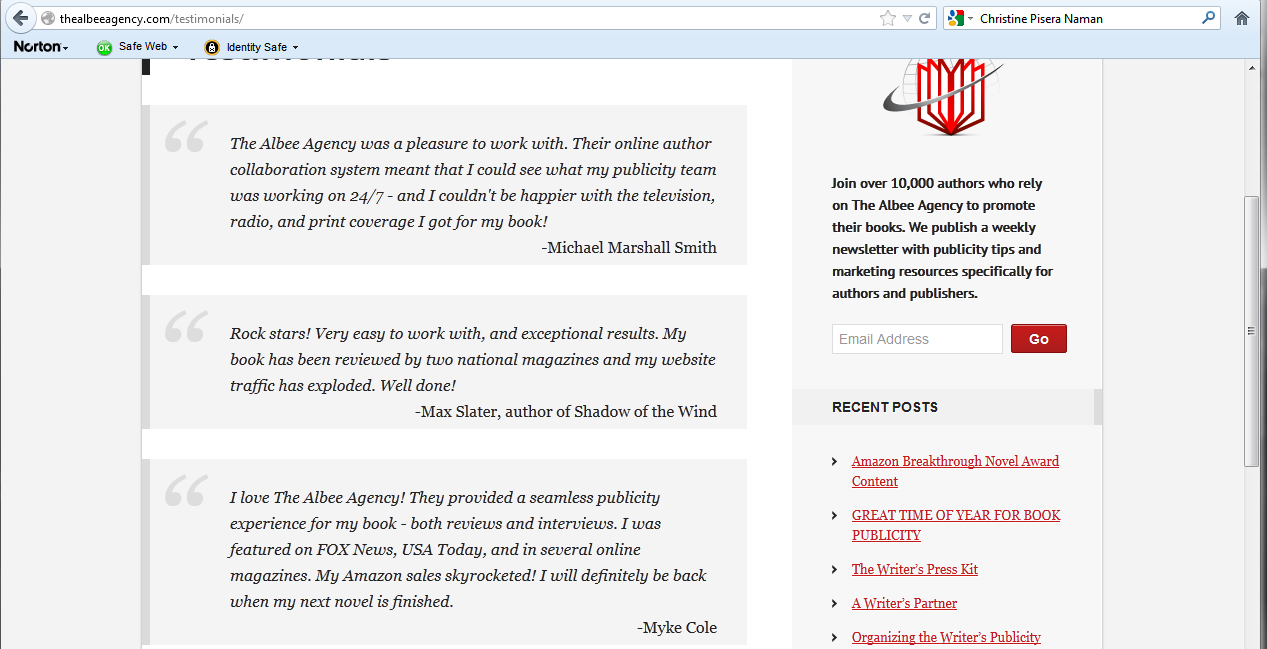
When I'm researching a website, I always vet the testimonials, because they can be, you know, fake. The very first Albee testimonial I checked caused warning bells to ring. (I'm providing screenshots below, rather than links--partly because the Albee website cycles content, so you won't necessarily get to the same page I did--and partly because I suspect the Albee website will shortly be changing.)

Take, for instance, this glowing praise from Amanda Keeling, author of Princess Story, Sheryl Reynolds, author of Free Admission, Stemphanie (no, that's not a typo) Lambert, "New York Times Best Selling Author," and Gene Sidow, author of Max Freeshot. Just one problem: I could find no evidence that either the authors or their books exist.


Now, these are all authors I'd never heard of before. Maybe their books never got published, or went out of print, or something. Maybe my Google-fu was just not up to par. But wait--here's an author I do know: Chuck Wendig (if you're not familiar with his blog, you should get to know it). Wow, Chuck really had a great experience with Albee, didn't he?


However, I have a suspicious mind. So I dropped Chuck a line, asking if he'd indeed hired The Albee Agency to do PR for him. His response:


Author Myke Cole also apparently luuuurves The Albee Agency:


And author Maureen Johnson is SUCH a fan:


However, their testimonials are no more authentic:


I haven't heard back yet from other authors I contacted, but I'm sure their response will be the same.

So....fake testimonials. Nonexistent authors; authors quoted without permission. There are no gray areas here: The Albee Agency is engaging in fraudulent behavior. This just emphasizes--as if y'all didn't already know--that writers need to watch out for scams.

The bigger point, though, is that even without the fake testimonials, there is plenty to beware of here. If Albee were absolutely, scrupulously honest about the authors it has worked with, it would still be offering services of dubious value for too much money, with no assurance of professional expertise.

And that, my friends, is a much bigger danger these days than an outright, bona-fide scam.

(Note: I emailed Chuck Wendig just before 3:00 this afternoon. By around 5:30, when I'd finished and proofed this post--which took me some time because of screenshotting and double-checking--most of the fake testimonials had vanished from Albee's website. The only testimonials that appear now are from Barry Krusch (who actually seems to exist) and "Suzie Plackson" (she seems to be real also, albeit with a different spelling.)

Edited 1/13/13 to add: The Albee Agency--which, amazingly, is still in business--now appears to be claiming that this and other blog posts about its attempts to hoodwink the public with false testimonials were "faked and paid for by a competitor" (presumably, Smith Publicity--see the comments to this post).

Wednesday, November 28, 2012

Archway Publishing: Simon & Schuster Adds a Self-Publishing Division

Posted by Victoria Strauss for Writer Beware

Well, it's happened again. Another traditional publisher has added a pay-to-play "division."

Yesterday, venerable trade publisher (and one of the Big 5) Simon & Schuster announced the launch of Archway Publishing, a self-publishing services provider.
"Through Archway Publishing, Simon & Schuster is pleased to be part of the rapidly expanding self-publishing segment of our industry," said Carolyn Reidy, president and CEO of Simon & Schuster. "Self-publishing has become a viable and popular route to publication for many authors, and increasingly a source of content for traditional publishers, including Simon & Schuster. We're excited that we'll be able to help more authors find their own path to publication and at the same time create a more direct connection to those self-published authors ready to make the leap to traditional publishing."
Like the other self-publishing divisions of trade publishers (LifeWay's Cross Books, Thomas Nelson's West Bow Press, Harlequin's Dell'Arte Press [which, unlike other ventures of this sort, produced a furore upon its introduction and had to change its name], Hay House's Balboa Press, and Writer's Digest's Abbott Press), Archway Publishing is outsourced to Author Solutions Inc. S&S is the biggest fish ASI has landed so far.

S&S seems to be hoping to differentiate Archway by presenting it as a "premium" service. According to the Archway (God, I have to stop thinking about those cookies) Free Publishing Guide--which you can't access without giving Archway your name, email, and phone number, even though it's present on the website behind a hidden URL--the familiar ASI basics are joined by such "unique" extras as inclusion in Edelweiss (a national bookseller catalog), a Speaker's Bureau, an author reception at BEA (cue eyeroll), and various video services (some of which are already available from ASI a la carte).

There's also a concierge service, where you work with just one person to coordinate all aspects of publication. Unlike the other extras, this doesn't appear to be included in any of the packages; nor could I find an a la carte price. Instead, Archway invites authors to call to learn more. Hmmm.   

As you might expect, with premium services go premium prices. Even by the standards of ASI--which is generally pricier than similar self-publishing service providers--the cost of Archway's packages is eye-popping. For fiction and nonfiction, prices start at $2,000 and rise to $15,000. Children's books are slightly more economical, beginning at $1,500 and topping out at $8,500. For the business package, you can't get in the door for less than $2,200, and if you go for the whole shebang you'll be on the hook for a cool $25Gs.

Plus, as with all the ASI "brands," there's a whole range of additional--and often highly dubious--"marketing" services you can drop big bucks on.

Archway Publishing has the S&S name in its logo. However, unlike West Bow Press, which prominently touts its connection with Thomas Nelson--or Dell'Arte Press, which doesn't mention Harlequin at all, anywhere--Archway is at some pains to make clear that while S&S has provided "guidance," it's ASI that's running the show. There's still the carrot, though.
Additionally, [ASI] will alert Simon & Schuster to Archway Publishing titles that perform well in the market. Simon & Schuster is always on the lookout for fresh, new voices and they recognize a wealth of talent in Archway authors.
Um, yeah. But that's not actually what Archway Publishing--or any of the pay-to-play subsidiaries of traditional publishers--is all about. What it's about is the money--publishers' desire to cash in on the boom in self-publishing services, and capture a piece of a lucrative revenue stream.

How lucrative, though? The action in self-publishing right now is in the ebook realm, where publishing services are available free. Beside Smashwords, Amazon's KDP program, PubIt! from Nook, etc., expensive POD-centric ASI-style services seem clunky and old-fashioned. Why invest in a costly publishing package when you can ebook for nothing on Smashwords, POD for nothing on CreateSpace, find reasonably-priced cover design services on DeviantArt, and so on?

Of course, there are people who don't want to DIY, and there's no shame in that. Even so, there's no reason to pay an arm and a leg for a publishing package. There are many service providers that are far more cost-effective than ASI.

Crucially, there are also many self-pub service providers that have far better reputations. It's not an exaggeration to say that, right now, ASI is the most hated name in the self-publishing services world. For why, do a search on "Author Solutions" on this blog, or take a look at Emily Suess's many posts about the company. Emily breaks it down:
 The short list of recurring issues includes: making formerly out-of-print works available for sale without the author’s consent, improperly reporting royalty information, non-payment of royalties, breech of contract, predatory and harassing sales calls, excessive markups on review and advertising services, failure to deliver marketing services as promised, telling customers their add-ons will only cost hundreds of dollars and then charging their credit cards thousands of dollars, ignoring customer complaints, shaming and banning customers who go public with their stories, and calling at least one customer a ‘fucking asshole.’
These are all very similar to reports Writer Beware has received over the years. ASI is the only self-pub service provider about which we get regular complaints.

Look, I understand why traditional publishers want to get involved with self-publishing. It's a business decision--a way for publishers to bring in money to help support their core operations. As long as the publisher doesn't misrepresent the benefits of paid self-publishing services, or mislead authors into thinking that using its service is a back door to a traditional book deal, or attempt to monetize its slush pile by steering rejected writers toward its service (see below), I can live with that.

(I can't help but roll my eyes when self-publishing advocates condemn traditional publishers for an outdated business model, yet get morally outraged when they actually change the model. But I digress.)

My problem is with how S&S and others have chosen to dabble in self-publishing--by choosing to work with a company that exploits authors through deceptive PR tactics, misleading rhetoric, and terrible customer service. ASI's poor reputation is not a secret--it's all over the Internet. Could S&S and others not have chosen a more complaint-free service provider--or, even, created the service themselves? You've got to at least give the much-reviled Book Country props for that.

There's also this disturbing tidbit in PW's coverage of the launch: "S&S will refer authors who submit unsolicited manuscripts to the Archway program." I didn't find this in other news coverage, and I'm hoping it's not true--or if it is true, that S&S will re-think it. Such referrals are seriously questionable, since authors who receive them are likely to give them more weight because they come from a respected publisher.

It's been pointed out by journalists and others covering the Archway launch that there's a weird twist to the story: ASI is part of S&S's competitor, Penguin Random House. When Penguin's parent company bought ASI and folded it into Penguin, I expressed the hope that Penguin would start to clean up the problems at ASI, make it more customer-friendly and transparent, as Amazon did years ago when it purchased the then-very-troubled BookSurge. I still hope that will happen--but I know better than to hold my breath.

Friday, November 16, 2012

Publishers Hate Authors? Really?

Posted by Victoria Strauss for Writer Beware

Without a doubt, the silliest publishing-related article I read this week was this one: "Why Book Publishers Hate Authors" by Michael Levin. (Although this one, which argues that e-reading isn't really reading, runs a close second.)

Levin's article is exactly what its title suggests: a screed on how, no matter how things might seem to the hopeful author or the uninformed observer, publishers just really despise authors. I mean, REALLY despise them. Why? Well, according to Levin, authors are flaky. They're anti-social. They miss deadlines. They ignore their editors' advice. On top of that--gasp--they expect to be paid! Some of them expect to be paid a lot! And publishers HATE that!
So it's understandable that publishers might feel churlish and uncharitable toward authors, on whom their entire publishing model depends. But since the 2008 economic meltdown hit Publishers Row, the enmity has turned into outright warfare.
This deadly conflict is "destroying the options of a writer," as well as "the uniqueness and creativity that readers expect when they buy a book." Publishers are striving, by various nefarious (and undisclosed by Levin) means, to "commoditize writing" in order to "keep the trains running on time" (i.e., protect their profit margins). It's all a diabolical plot--"maybe," muses Levin, "publishers are actually happy when authors fail"--and just one more reason why "book publishing as we know it is going over the cliff."

Gosh! Maybe the US Justice Department should get involved!

Some of what Levin says is true. Returns are a problem, and publishers have curbed print runs to address this (though print run deflation long pre-dates the 2008 economic meltdown, which Levin blames for much of the publisher evil he describes). Bloated advances--while the exception--are a problem. And if you're an author with lackluster sales, BookScan numbers are indeed something you drag around with you like Marley's chains, and can affect your ability to sell subsequent books. Writing under a new name may fool readers and booksellers--but publishers always know who you are.

But does all of this (and don't forget that famous author flakiness) really turn publishers into haters? Does it really drive them to wage covert warfare on the content suppliers that keep them in business? Does it--as Levin explicitly claims--actually benefit publishers to destroy writers' options and careers? Levin's case might be more compelling if he supported it with real evidence or reasoned argument. But he doesn't. Instead, all he offers is a tautology. Authors are flaky and bad things are happening in publishing. Publishers must hate authors. How do we know? Because authors are flaky and bad things are happening in publishing.

Levin makes some other dubious assertions. Publishers are not, as he claims, moving en masse to "a minimal or even zero advance business model." Publishers don't do "zero marketing"--what, does Levin think they want to lose money? How does this fit with his claim that they're doing all this anti-author stuff in order to protect their profit margins?

Levin also says that publishers are striving to "turn writing into a fungible commodity...[so] they're no longer at the mercy of unruly, unmanageable and unpredictable writers." He neglects, however, to provide any examples of how this is occurring or what form it's taking (not surprising, for such a vague and sweeping claim). And then he invokes this doomsday scenario:
The problem is that [publishers] destroy the uniqueness and creativity that readers expect when they buy a book. As the quality of books diminishes, book buyers are less likely to turn to books the next time they need to get information about a given topic. They'll go to Wikipedia, they'll do a Google search, they'll phone a friend. But they won't buy another book.
Yes, it's the "death of books" meme. (There ought to be some kind of corollary to Godwin's Law for bringing this up in a discussion of publishing.) At which point you just have to shake your head. Plus, Levin appears here to be talking about nonfiction--since readers don't generally turn to fiction to "get information about a given topic." Is he really extrapolating from an opinion about nonfiction to all books everywhere?

Look, the book business is tough. There's an inherently adversarial aspect to the author-publisher relationship, often expressed in contract negotiations. Authors frequently find themselves at the bottom of the food chain, and must struggle to survive and to thrive. Good books fall through the cracks; things go wrong and writers get screwed (we've all heard the horror stories). Not only that--we're in the midst of cataclysmic change.

But publishers don't "hate" authors, and they're not engaging in any shadowy conspiracies to destroy their careers or their creativity. It's absurd to suggest otherwise--not only because it makes no logical or economic sense, but because companies don't have emotions. People have emotions. And if you've ever worked with people in the book business, you'll know how many of them truly love books and writing--and writers, flaky though they be.

But if publishers don't hate authors, authors sure do hate publishers. Whether from angry rejected writers who want to blame anyone but themselves, or self-publishing evangelists eager to dance on traditional publishing's grave, the chorus of publisher-hating is getting louder every day. That's the real message of Levin's bitter screed (though I'm sure he didn't intend it that way). Sadly, it will fall on receptive ears.

Tuesday, November 13, 2012

Guest Blog Post: Mustering the Courage to Turn Down a Publishing Contract

Posted by Victoria Strauss for Writer Beware

I've seen a slew of bad publishing contracts lately, which makes this guest blog post by author Kfir Luzatto especially resonant for me. Turning down a publishing offer when you have one in hand is one of the toughest decisions you will ever have to make...but sometimes, if the publisher has a poor reputation or the contract terms are bad, it's the wise thing to do.

To Kfir's good advice, I'd add one nugget of my own: don't wait until after you have a contract in hand to research the publisher. You will save yourself a ton of grief (and, possibly, an agonizing decision process) if you check publishers' reputations before sending off a query.

Scroll down to the bottom of the post for some good resources for checking publishers' reputations, getting feedback from other writers, and learning more about publishing contracts.

------------------------------------

MUSTERING THE COURAGE TO TURN DOWN A PUBLISHING CONTRACT
by Kfir Luzzatto

Only few emotions compare with the elation of an author, who opens an envelope (whether a paper or a virtual one) and reads the beautiful words, “…we would like to publish your novel.” Winning a lottery is probably like it (although I wouldn’t know, I never won one), and some authors have gone as far as to liken it to the birth of their first child.

But sticking to the lottery simile, imagine being asked to “be reasonable and tear the winning ticket up”. To be able to even consider it you must first realize that you’d be tearing up your ticket to hell — but that doesn’t make it any easier.

Love is blind, and your love for your book is blind and deaf and numbs your senses, starting with your common sense. You read that contract and your brain realizes that your future publisher can’t spell (which can’t be a good sign), but your heart refuses to acknowledge it; you skip the payment clauses because you know that there will be no real money there, but what really matters to you is to get the book published, even if it means ignoring all the good advice that you have found posted on Writer Beware and all over the web.

This is the time to sit down and consider all the good reasons for turning that contract down. I’ve been there and done that, so I know it isn’t easy, but a man’s gotta do what a man’s gotta do (and a woman too). Here are ten tips to help you through it:

1. When that letter comes in, don’t start calling everybody to brag about it. Don’t tweet it; leave your Facebook status alone. Make extra sure that it is the real thing before you tell the world.

2. Make sure that you have not been offered a vanity publishing contract. If that’s what it is you must simply trash it and stop thinking about it. It doesn't deserve any of your time and emotions. It’s spam and should be treated like it.

3. Be optimistic, but...a pessimist is an experienced optimist, and experience shows that bad contracts float around in droves, so yours may turn out to be one of those. Start your review of the contract with a low level of expectation.

4. Check out the expected publication date. If the contract speaks of publication in one or two years, take time to consider your options; what’s the rush anyway?

5. Now that you have calmed down and realize that not all that glitters may be gold, do yourself a favor and analyze the contract taking advantage of the many useful resources available on the web, for instance, here.

6. Take advice from others. Writing can be a very solitary endeavor, but if you’ve been at it for a while and have developed relationships with other authors, listen to what they have to say about the publisher, a clause that you find jarring and anything else that you may want to ask them.

7. It is not uncommon for new authors to submit to numerous publishers taken from lists found on the web, which may be old and outdated, or simply not based on much insight into the business of those listed. If you haven’t researched this particular publisher really thoroughly before submitting, now is the time to do it. If you find off-putting references to it on the web it may make your decision to turn the contract down much easier.

8. Think positively. Notwithstanding the bad contract, the publisher in most cases is not a scammer and he really liked your work, which means that your novel is worthy and perhaps you can place it with a better publisher, who will offer you a reasonable contract.

9. Realize that this is not a failure — it’s your decision. You and you alone have the power over the fate of your work. Just like you wouldn’t send your kid to a bad school because it is a couple of blocks closer to your home, you are not sending your brain child to a bad publisher simply because he’s the first one who sent you a contract.

10. Remind yourself that each battle of wills between your brain and your heart is a big stop on the learning curve of the writing business. You will emerge from it a better and stronger author.

But then, you may worry, what happens if this is the only contract offer I’ll ever get? Won't I feel as if I have wasted my only chance?

Heck, no! If you believe in your work you know that other, better opportunities will come along. And if you don't believe in it, what’s the purpose of publishing it anyway?

Kfir Luzzatto is the author of five published novels and several short stories. You can read his blog at www.kfirluzzatto.com and follow him on Twitter at @KfirLuzzatto.

---------------------------------

HELPFUL RESOURCES

Publisher Cautions and Checking Reputations:
Publishing Contract Resources:
Writer Beware Blog Posts on Contract Issues:

Wednesday, November 7, 2012

PASSION BLUE Release and Giveaway!

Posted by Victoria Strauss

We don't often do self-promotion here at Writer Beware--but yesterday was publication day for my young adult historical fantasy Passion Blue--a novel of art, astrology, and romance set in Renaissance Italy.

I'm incredibly excited to have it out there in the world at last, and for the wonderful reviews it has been receiving (Kirkus gave it a star). It's published for the older teen market, but it has plenty of crossover appeal for adults (as indeed do a lot of YA books these days).

I've got a blog tour scheduled for November, with interviews, guest posts, giveaways, and more--the full schedule is posted at my website. I'll be posting links daily on my personal blog.

I'm also conducting a giveaway to celebrate Passion Blue's release. You can enter to win one of 3 great prize packs: a signed hardcover, Passion Blue swag, and a $25 Amazon gift card. Please feel free to post the giveaway on Twitter, Facebook, etc., or to feature it on your blog. Thanks so much!


Amazon Children’s Publishing
ISBN: 978-0761462309


Hardcover: $17.99
Ebook: $3.99

Order from Amazon
Order from Barnes & Noble
Order from IndieBound

Download an excerpt

Be sure you know your true heart’s desire, or you may find yourself surprised by what you receive.

This is the warning the Astrologer-Sorcerer gives Giulia when she pays him to create a magical talisman for her. The scorned illegitimate daughter of a Milanese nobleman, Giulia is determined to defy the dire fate predicted by her horoscope, and use the talisman to claim what she believes is her heart’s desire: true love and a place where she belongs–not likely prospects for a girl about to be packed off to the cloistered world of a convent.

But the convent of Santa Marta is full of surprises. There are strict rules, long hours of work, and spiteful rivalries…but there’s also friendship, and the biggest surprise of all: a workshop of female artists who produce paintings of astonishing beauty, using a luminous blue mixed from a secret formula: Passion blue. Yet even as Giulia begins to learn the mysteries of the painter’s craft, the magic of the talisman is at work, and a forbidden romance beckons her down a path of uncertainty and danger. She is haunted by the sorcerer’s warning, and by a question: does she really know the true compass of her heart?

Set in Renaissance Italy, this richly imagined novel about a girl’s daring journey towards self-discovery transports readers into a fascinating, exotic world where love, faith, and art inspire passion–of many different hues.

PRAISE FOR PASSION BLUE
 
A rare, rewarding, sumptuous exploration of artistic passion.
- Kirkus (starred review, editor’s pick for Fall 2012) 

Vividly set during the 15th-century Italian Renaissance, Strauss’s novel has a strong and thoroughly likable heroine who is only one of many well-developed female characters.
- School Library Journal 

Giulia’s unusual story is sure to capture readers’ attention.
- Publishers Weekly 

I don’t just like Passion Blue, I love it...I simply galloped through it.
- Jane Yolen, author of The Devil’s Arithmetic

Strauss combines the spiritual with a hint of the supernatural to tell a story about a girl’s journey to both freedom and passion. A lovely read.
- Megan Whalen Turner, author of The Queen’s Thief series 

An elegant retelling of that old, crucial story of finding one’s place in the world, set against a vivid evocation of the Italian Renaissance.
- Robin McKinley, author of The Hero and the Crown

A glimpse of 15th century Italian life as sure-handed and brilliantly illuminated as the work of a Renaissance master…Passion Blue is both a soul-felt journey and a triumphant work of art.
- Meredith Ann Pierce, author of the Darkangel Trilogy 

A lush, vibrant read that is utterly transporting.
- Lesley Livingston, author of the Wondrous Strange series